
The FBI’s meticulous efforts, including tracking digital footprints and leveraging informants, ultimately led to Ulbricht’s capture in a San Francisco library. His trial and subsequent conviction on charges including narcotics trafficking and money laundering underscored the challenges of maintaining anonymity in the digital age. Despite the attempts to secure the Silk Road’s activities, the platform caught the attention of law enforcement. In 2013, the FBI successfully traced Ulbricht and seized the Silk Road. Ross Ulbricht was arrested and sentenced to life in prison, marking one of the first significant takedowns of a dark web marketplace.
Hector Xavier Monsegur was an unusual visitor to the New York FBI office. It was past 1 am one night in the spring of 2011, and he was being led to the back of the empty bullpen by Chris Tarbell, a young agent who had arrested Monsegur earlier that night in the Jacob Riis Houses on the Lower East Side. Monsegur was an enormous Puerto Rican, ears studded with diamonds, who grew up in the projects. He was also Sabu, a cofounder of LulzSec, the elite group of hackers responsible for electronically attacking dozens of corporate and government targets like News Corp. and the CIA. Sabu was the most high-profile member of Anonymous, the “hacktivist” political collective.
What Has Replaced Silk Road As The Biggest Dark Web Marketplace?
The world of dark web markets has undergone a dramatic evolution over the past decade. What began as a bold digital experiment has become a global underground economy, constantly shifting in response to law enforcement, technology, and user demand. To understand how we got here, it’s essential to trace the journey from the infamous Silk Road to the sophisticated marketplaces that exist today.
Our Network
Lyn Ulbricht still denies her son participated in those incriminating chats with Bates and Variety Jones and the fake assassins. “There is no proof of who is behind that computer screen, or if it’s one or more people using that name,” she wrote in an email to Newsweek. Ulbricht’s site operated as a Tor hidden service, making it easier for its users to browse it anonymously and conduct all their transactions using untraceable cryptocurrencies. President Trump announced Tuesday that he has pardoned Ross Ulbricht, the founder of Silk Road, an underground website that the FBI once called “the most sophisticated and extensive criminal marketplace on the internet.” “Ross Ulbricht, Aka Dread Pirate Roberts, Sentenced to Life in Federal Prison for Creating, Operating “Silk Road” Website.” Www.ice.gov, 29 May 2015, /news/releases/ross-ulbricht-aka-dread-pirate-roberts-sentenced-life-federal-prison-creating.
Ross Ulbricht, The Creator And Owner Of The “Silk Road” Website, Found Guilty In Manhattan Federal Court On All Counts
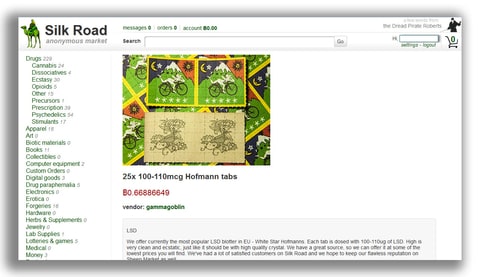
In 2011, Ulbricht, an Eagle Scout from Austin, Texas, founded Silk Road, an online black market that existed until his arrest, in 2013, for crimes related to drug trafficking, money laundering, and computer hacking. According to authorities, more than a million transactions took place on Silk Road, out of the government’s regulatory reach, generating more than two hundred million dollars in revenue. Drugs like methamphetamine, cocaine, and heroin made up a huge portion of the site’s sales, from which Ulbricht apparently took millions in commissions. Silk Road “lowered the barriers to drug dealing by enabling drug dealers to reach customers online they could have never met on the street,” a federal prosecutor said in a closing argument. The Silk Road, an online black market created by Ross Ulbricht in 2011, revolutionized the way illegal transactions were conducted on the internet. By leveraging the anonymity provided by Bitcoin and the Tor network, Silk Road facilitated the sale of drugs and other illicit goods, drawing significant attention from law enforcement agencies worldwide.
Legal And Privacy
However, the Hidden Wiki is a generic name used by several directories. We have all heard the stories, so why not explore the Dark Web for yourself? If all this seems like a total minefield, find out how to get started, plus 14 of the best dark web websites to explore in 2025. This article contains graphic images of injecting drug use. A picture may be worth …

Legal Issues Surrounding The Silk Road
As the narrative unfolds, viewers learn about the intense efforts of multiple law enforcement agencies to shut down the Silk Road and apprehend its creator. It showcases the largest online manhunt in history, involving Homeland Security, the DEA, the FBI, and even the Secret Service. Interestingly, it was a young tax inspector from the IRS, Gary Alford, who ultimately cracked the case and unmasked the elusive “Dread Pirate Roberts”.
What Happened To The Bitcoins Seized From Silk Road?
The documentary provides insight into the sophisticated infrastructure of the Silk Road, which operated as a hidden service on the Tor network. This setup ensured user anonymity and made it challenging for law enforcement to track transactions. It details how the site facilitated sales amounting to over 9.5 million Bitcoins between February 2011 and July 2013, highlighting the scale of its operations. In the context of the dark web, the Silk Road refers specifically to an online black market that surfaced in 2011. Here, users could buy and sell various goods and services anonymously.
Silk Road’s Operations
After Ulbricht opened his laptop and started typing away, a man and woman beside him broke out into an argument that quickly escalated to the point of physicality. When Ulbricht turned to look, another woman sitting across from him gracefully swooped up his open laptop and then passed it to a man walking by, mid-stride. By the time Ulbricht realized that everyone involved in this scene—the new employee, the arguing couple, the woman across from him, the man walking by—were all undercover agents, he was already in handcuffs.
- Sitting in the Marriott, Force received a PDF of the target, opened it, and discovered a scan of Green’s driver’s license photo.
- Ulbricht was arrested and the FBI seized his laptop on October 1, 2013.
- The Silk Road black market could only be accessed by buyers and sellers using the Tor web browser and a compatible search engine.
- Ulbricht was arrested in San Francisco in October 2013, and Silk Road was shut down later that month.
- However, the main difference is that accessing it via a Tor browser gives you a layer of anonymity and security.
- They offer services such as market penetration testing and market development/hosting assistance.
“I had left my promising career as a scientist to be an investment adviser and entrepreneur and came up empty-handed.” Ross felt ashamed, but not long afterward Palmertree got a job in Dallas, leaving Good Wagon to Ross. Ulbricht expressed remorse for his actions and said that the site had meant to enact his libertarian views. Although multiple copycat sites (such as Silk Road 2.0, which sprung up in November 2013) attempted to replace the original, they were quickly shut down by law enforcement. Many sites continue to use the name, though they have no connection to the original. Anonymous browsing with a VPN or other encryption services will help hide your online activity from your government, ISP, or other prying eyes.
As his site grew, the government took notice, and Ulbricht impishly reveled in the attention. As some U.S. senators called for Silk Road to be shut down, Ulbricht made a chipper comment to Bates in a chat about how yet another national media outlet had mentioned his grand blow for freedom. Meanwhile, federal agents in Maryland and Chicago were on his trail. By July 2013, the feds were so inside the Silk Road system that an agent was able to assume the online identity of a member of the Silk Road staff.
Working nonstop, they were able to find the master password in the laptop’s RAM. Finding the trail that connected those two characters—and revealing them to be the same person—took two-and-a-half years, multiple government agencies, and the coordination of both digital and physical forensics. The young philosopher kingpin who freed drug users from the locavore 20th century model of drug selling—street corners, landlines, bike messengers—is now paying for that with his own liberty, and facing a future his mother calls, simply, “grim.” Dratel also argued in court that the FBI probably had help from an agency, like the National Security Agency (NSA), in locating the servers in Iceland. Although we are cheekily warned from the start that “this story is true. Except for what we made up or changed”, there are clearly some aspects of the tale that are simply there to pad out an otherwise stale and meandering screenplay.